Updated: August 26, 2026
If you are looking for the best smartphones to buy in 2026, there are more excellent choices than ever. Flagship phones now combine powerful processors, advanced cameras, long software support, fast charging, AI features and high – quality displays.
But the most expensive phone is not automatically the best phone for everyone.
For 2026, our shortlist focuses on phones with a strong combination of performance, cameras, battery life, software, long-term support and overall value. Prices and availability vary significantly by country, retailer, storage option and promotions, so this guide focuses primarily on the products and features rather than temporary deals.
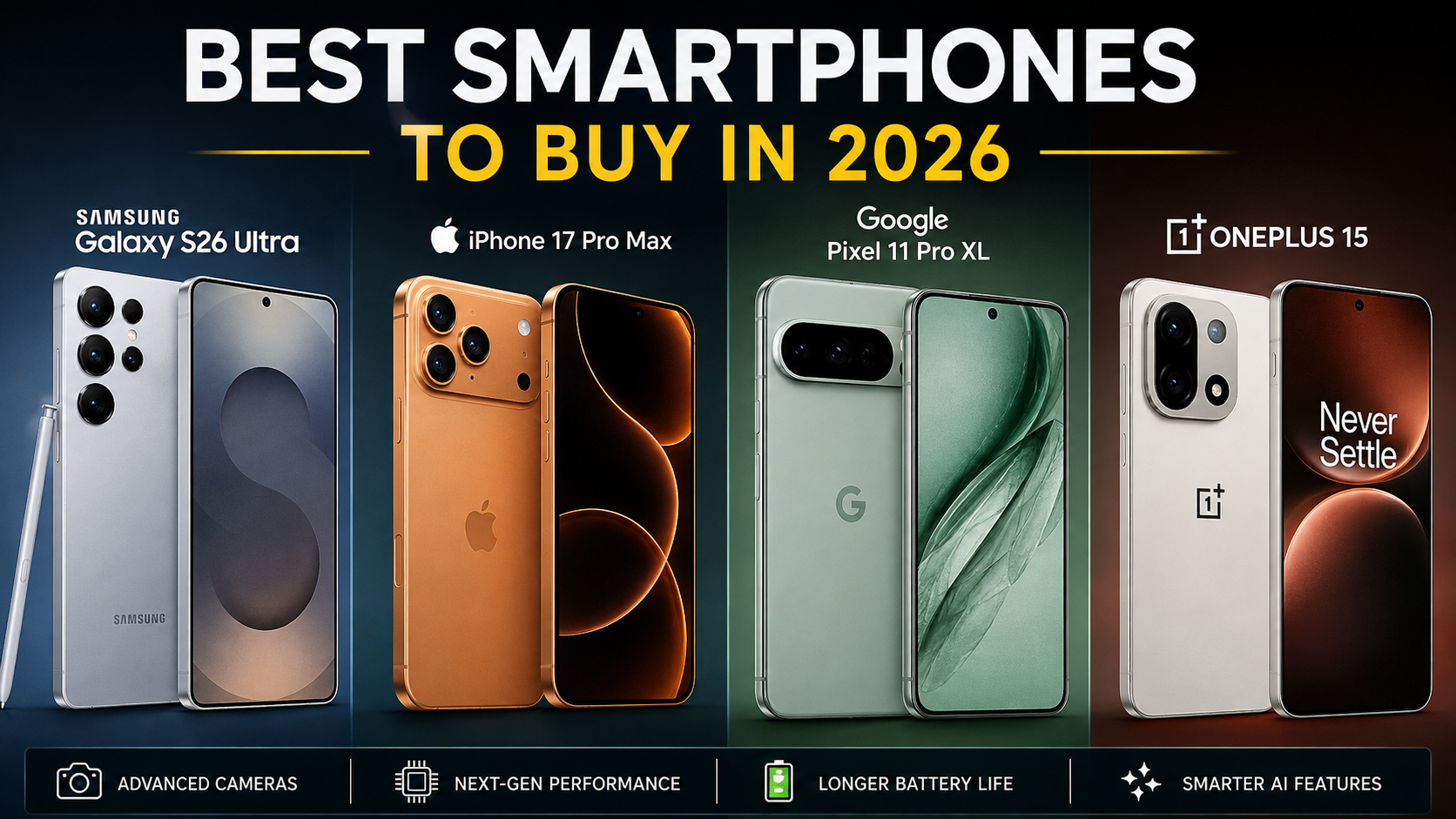
Best smartphones to buy in 2026 at a glance
| Smartphone | Best for | Key strength |
|---|---|---|
| Samsung Galaxy S26 Ultra | Best overall Android flagship | Cameras, S Pen, display and privacy features |
| iPhone 17 Pro Max | Best iPhone for power users | Performance, cameras, video and battery life |
| Google Pixel 11 Pro XL | Best for AI and photography | Gemini features, cameras and software |
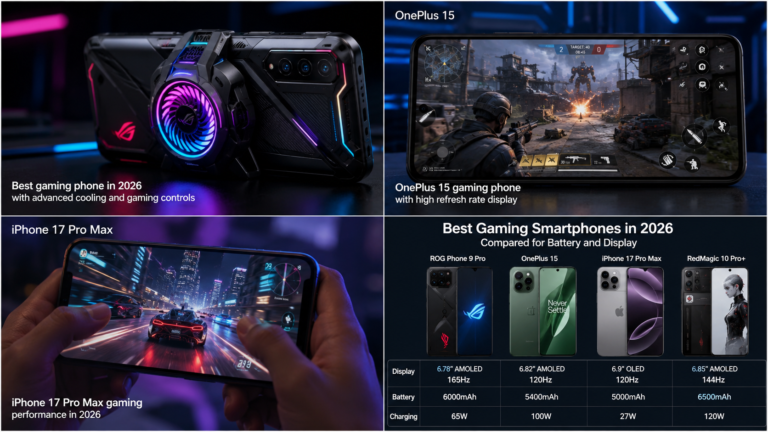
| OnePlus 15 | Best for battery and performance | Large battery, fast charging and gaming |
| Google Pixel 11 | Best balanced Pixel | Flagship – style features in a smaller package |
| iPhone 17 | Best mainstream iPhone | Strong all – round iOS experience |
| Google Pixel 11 Pro | Best compact premium Android | Pro cameras and AI in a smaller format |
Read also :- Vivo IQOO Neo9 and Neo9 Pro: True next-gen flagship-killers announced
1. Samsung Galaxy S26 Ultra – Best overall Android flagship
The Samsung Galaxy S26 Ultra is one of the strongest choices for people who want an almost no-compromise Android smartphone.
Samsung equips it with a 6.9 – inch display, a built-in Privacy Display, a 5,000mAh battery and a high-end multi-camera system. The rear setup includes a 200MP main camera, 50MP ultra-wide camera, 50MP telephoto camera and 10MP telephoto camera. It also supports the S Pen.
Key specifications and features
- 6.9 – inch display
- Built – in Privacy Display
- 200MP main camera
- 50MP ultra – wide camera
- 50MP telephoto camera
- 10MP telephoto camera
- 5,000mAh battery
- Integrated S Pen
- Samsung’s latest Galaxy AI features
- 214g weight and 7.9mm thickness
Samsung says the S26 Ultra’s customized processor delivers improved CPU, GPU and NPU performance, while the Privacy Display can hide the entire screen or selected information from people viewing the phone from the side.
Performance
The S26 Ultra is aimed at demanding users. It has the hardware needed for gaming, multitasking, photography, video editing and AI-powered features.
For most people, the performance ceiling is far beyond what is required for everyday apps such as messaging, social media, browsing and streaming.
Camera
The camera system is one of its biggest attractions.
The 200MP main camera is joined by high – resolution ultra-wide and telephoto cameras, giving the phone flexibility for landscapes, portraits and distant subjects. The dedicated telephoto cameras are especially useful if you frequently photograph subjects that are far away.
Battery and charging
Samsung lists a 5,000mAh battery and up to 31 hours of video playback for the S26 Ultra. The company also says the phone can reach up to 75 % charge in around 30 minutes under its specified charging conditions.
Pros
- Excellent all-round flagship hardware
- Versatile camera system
- Large, high – end display
- Integrated S Pen
- Built-in Privacy Display
- Strong productivity features
Cons
- Large and relatively heavy
- Premium pricing
- Many users will not need its most advanced features
Who should buy it ?
The Galaxy S26 Ultra is a strong choice if you want the best Android features in one device, especially if you use a stylus, take lots of photos, multitask heavily or want a large display.
Who should avoid it ?
Avoid spending extra on the Ultra if you mainly use your phone for messaging, social media, calls, browsing and basic photography. A less expensive Galaxy model can handle those tasks easily.
2. iPhone 17 Pro Max – Best iPhone for power users
The iPhone 17 Pro Max is the flagship choice for users who prefer Apple’s ecosystem and want maximum iPhone performance, camera capability and battery life.
Apple’s current Pro models use the A19 Pro chip, a new aluminium unibody design and a three-camera 48MP Fusion system. The Pro Max has a 6.9-inch Super Retina XDR display and supports ProMotion up to 120Hz.
Key specifications and features
- 6.9-inch Super Retina XDR display
- ProMotion up to 120Hz
- A19 Pro chip
- Three 48MP rear cameras
- 8x optical-quality zoom
- 18MP Center Stage front camera
- iOS 26
- Apple Intelligence
- Up to 37 hours of video playback according to Apple
Apple says the iPhone 17 Pro Max delivers its best-ever iPhone battery life, with up to 37 hours of video playback. It also supports up to 50% charge in 20 minutes with a high-wattage power adapter under Apple’s stated conditions.
Performance
The A19 Pro is designed for demanding applications, advanced games, video work and on-device AI.
For people already invested in Apple’s ecosystem, the overall experience is also important. Features such as iCloud, AirDrop, Apple Watch integration and other Apple services can make the phone particularly convenient for existing Apple users.
Camera
Apple has upgraded the Pro camera system with three 48MP rear cameras.
The telephoto camera provides up to 8x optical-quality zoom, while Apple’s video features continue to target users who want advanced recording and editing capabilities.
Battery and charging
Battery life is one of the major reasons to choose the Pro Max rather than a smaller iPhone.
Apple rates the iPhone 17 Pro Max for up to 37 hours of video playback. Actual battery life will vary with network conditions, screen brightness, apps and usage patterns.
Pros
- Extremely powerful processor
- Excellent camera and video capabilities
- Large 6.9 – inch display
- Strong battery life
- Long-term iOS ecosystem support
- Premium build
Cons
- Expensive
- Large and heavy compared with smaller phones
- iOS is less customizable than Android in some areas
Who should buy it ?
Choose the iPhone 17 Pro Max if you want the most capable large iPhone and regularly use demanding apps, photography, video or gaming.
Who should avoid it?
If you prefer a smaller phone or do not need professional-level camera and performance features, the standard iPhone 17 may offer better value.
3. Google Pixel 11 Pro XL – Best for AI and photography
Google’s Pixel 11 series arrived in August 2026, making the Pixel 11 Pro XL one of the newest flagship choices available.
Google says the Pixel 11 Pro and Pro XL use the Tensor G6 processor and bring major camera upgrades, enhanced durability and deeper Gemini integration. The Pro models feature Super Actua displays with brightness of up to 3,600 nits.
Key specifications and features
- Tensor G6 processor
- Super Actua display
- Up to 3,600 nits brightness on Pro models
- Upgraded camera hardware
- Gemini-powered features
- Titan M3 security chip
- 256GB and 512GB storage options in India
- Qi2.2 25W compatibility
- Seven years of OS, security and Pixel Drop updates
Google states that Pixel 11, Pixel 11 Pro and Pixel 11 Pro XL receive seven years of OS, security and Pixel Drop updates.
Performance and AI
Google’s approach is different from simply chasing benchmark numbers.
The Pixel 11 Pro XL puts considerable emphasis on AI-assisted features, Gemini and on-device processing. Google says Tensor G6 works with the latest Gemini Nano model and provides significantly faster on-device AI processing than the previous generation.
Camera
Photography remains a major reason to consider a Pixel.
Google says the Pixel 11 Pro and Pro XL use a new main sensor and an upgraded 48MP telephoto camera. The Tensor G6 also helps process images and video using Google’s computational photography technology.
Security and software
The Pixel 11 series is particularly interesting for users who care about software longevity.
Google says the phones combine the Tensor G6 processor with the Titan M3 security chip and introduce post-quantum cryptography for secure boot.
Pros
- Strong AI integration
- Advanced computational photography
- Seven years of updates
- Bright Pro display
- Strong security focus
- Clean Android experience
Cons
- AI features can vary by language and country
- Not every user needs Google’s AI tools
- Hardware priorities differ from performance-focused gaming phones
Who should buy it?
The Pixel 11 Pro XL makes sense for people who want excellent cameras, long software support and Google’s latest AI features.
4. OnePlus 15 – Best for battery life and performance
The OnePlus 15 is particularly interesting for users who prioritize battery capacity, charging speed, gaming performance and a smooth display.
OnePlus lists a 7,300mAh battery, a 6.78 – inch display with up to a 165Hz gaming refresh rate, Snapdragon 8 Elite Gen 5, up to 16GB RAM and 256GB or 512GB storage depending on configuration.
Key specifications and features
- 6.78-inch display
- Up to 165Hz gaming refresh rate
- Snapdragon 8 Elite Gen 5
- 7,300mAh battery
- Up to 120W SUPERVOOC charging depending on market
- 50W wireless charging
- Triple 50MP rear camera system
- 3.5x optical telephoto
- OxygenOS 16 based on Android 16
OnePlus notes that charging specifications vary by market, so buyers should check the local model before purchasing.
Performance
Performance is one of the phone’s main selling points.
The combination of a flagship Snapdragon platform, fast storage, high RAM configurations and a high-refresh-rate display makes the OnePlus 15 especially attractive to gamers and power users.
Battery and charging
The 7,300mAh battery is unusually large for a flagship smartphone.
OnePlus claims up to 31 hours of video playback and supports fast wired and wireless charging, although charging speed differs between regions.
Camera
The OnePlus 15 uses three 50MP rear cameras: main, ultra-wide and telephoto.
The telephoto camera offers 3.5x optical zoom and up to 7x optical-quality zoom according to OnePlus.
Pros
- Very large battery
- Excellent performance potential
- High – refresh – rate display
- Fast charging
- Flexible triple – camera system
- Strong gaming features
Cons
- Camera processing may appeal less to users who prioritize Pixel – style photography
- Charging specifications vary by market
- Large battery contributes to a heavier design
Who should buy it ?
The OnePlus 15 is a strong choice if you want long battery life, fast charging and high gaming performance without automatically choosing the most expensive ultra-premium phone.
5. Google Pixel 11 – Best balanced Pixel
Not everyone needs a giant Pro XL.
The standard Google Pixel 11 provides many of Google’s newest software and camera features in a more conventional flagship package.
Google says the Pixel 11 uses Tensor G6, a new larger 48MP main sensor and a 5x telephoto camera capable of up to 30x Super Zoom.
It also receives seven years of OS, security and Pixel Drop updates.
Best for
- Everyday photography
- Google AI features
- Long software support
- Users who prefer a smaller flagship
- People who do not need every Pro camera feature
The Pixel 11 is worth considering when the Pro XL’s extra hardware does not justify its higher cost.
6. iPhone 17 – Best mainstream iPhone
The iPhone 17 is a better fit for many people than the Pro models.
Apple’s current iPhone lineup includes the iPhone 17, iPhone Air, iPhone 17e and Pro models, giving buyers several price and feature levels.
The standard iPhone 17 is particularly attractive if you want:
- iOS
- Strong everyday performance
- Apple’s ecosystem
- A premium display
- Good cameras
- A more reasonable price than the Pro Max
You should move to the Pro models mainly when you specifically need their additional camera, performance or battery capabilities.
Best smartphones in 2026 compared
| Phone | Best for | Performance | Camera focus | Battery focus | Software |
| Galaxy S26 Ultra | Best Android all-rounder | Excellent | Versatility & zoom | Strong | Android / One UI |
| iPhone 17 Pro Max | Power users | Excellent | Photo & video | Excellent | iOS 26 |
| Pixel 11 Pro XL | AI & photography | Excellent | Computational photography | Strong | Android |
| OnePlus 15 | Gaming & battery | Excellent | Triple-camera flexibility | Exceptional | OxygenOS 16 |
| Pixel 11 | Balanced Android | Excellent | Everyday photography | Strong | Android |
| iPhone 17 | Everyday iPhone | Excellent | Everyday photography | Strong | iOS 26 |
Important: Specifications, software features, network compatibility, charging speeds, storage options and availability can differ by region. Always verify the exact local model before buying.
How to choose the best smartphone in 2026
There is no single phone that is perfect for everyone. Start with the things you actually use every day.
1. Choose your operating system first
The first major decision is Android versus iOS.
Choose Android if you want:
- More customization
- More hardware choices
- Different price levels
- Flexible multitasking
- Features such as Samsung’s S Pen
Choose iPhone if you want:
- Apple’s ecosystem
- iOS
- Easy integration with other Apple devices
- Strong video capabilities
- Apple’s services and accessories
Switching platforms is possible, but it is worth considering your existing devices and apps before buying.
2. Don’t choose a phone based only on camera megapixels
A 200MP camera does not automatically produce better photos than a 48MP camera.
Image quality also depends on:
- Sensor size
- Lens quality
- Image processing
- Stabilization
- Autofocus
- HDR processing
- Low-light performance
- Telephoto hardware
Look at the complete camera system rather than one number.
3. Check software support
A phone can remain physically useful for many years, but software support matters just as much.
Before buying, check:
- How many Android or iOS updates are expected
- How long security updates will continue
- Whether important features are available in your country
- How quickly updates normally arrive
- Whether the manufacturer has a clear support policy
For example, Google says the Pixel 11 series receives seven years of OS, security and Pixel Drop updates.
4. Think about battery size and charging together
Battery capacity is only one part of battery life.
A phone with a smaller battery can sometimes last longer because of its processor, display and software efficiency.
Also check charging standards and regional differences. The OnePlus 15, for example, has different wired charging specifications in different markets.
5. Consider storage carefully
Modern smartphones can record high-resolution photos and videos that consume storage quickly.
For many users:
- 128GB can be enough for light use
- 256GB is a comfortable starting point for many buyers
- 512GB makes sense for heavy photography, video or gaming
- 1TB or more is mainly for very heavy users
Remember that advertised storage is not the same as available storage because the operating system and pre – installed software use some space.
Common smartphone buying mistakes
Buying the most expensive model automatically
The Ultra or Pro Max model may have impressive specifications, but those features can be unnecessary for ordinary users.
Ignoring software updates
A cheaper phone with poor long-term support may cost more in the long run if you replace it sooner.
Looking only at benchmark scores
Benchmark performance does not tell the whole story.
Display quality, battery efficiency, camera processing, thermal performance and software experience matter during everyday use.
Buying the wrong regional model
International smartphone variants can have different:
- 5G bands
- SIM configurations
- Charging speeds
- Warranty coverage
- Storage options
- Software features
Always verify the exact model number and network compatibility before importing a phone.
Chasing temporary discounts
A large discount is not necessarily a good deal if the phone is old, has limited software support or does not meet your needs.
Compare the total value rather than focusing only on the percentage discount.
Safe smartphone buying tips
Buy from reputable retailers or official manufacturer stores whenever possible.
Before paying, check:
- Exact model number
- Storage capacity
- Warranty terms
- Return policy
- Network compatibility
- Charger availability
- Regional software differences
- Seller reputation
Be especially careful with extremely cheap marketplace listings. A price that looks dramatically lower than the normal market price deserves extra verification.
Never send payment information, passwords or verification codes to someone claiming to represent a phone manufacturer unless you have independently confirmed the contact.
Which smartphone should you buy ?
The answer depends on what matters most to you.
Choose the Samsung Galaxy S26 Ultra if you want the most feature-packed Android flagship, particularly for cameras, productivity and the S Pen.
Choose the iPhone 17 Pro Max if you want Apple’s highest-end large iPhone with exceptional performance, camera and video capabilities.
Choose the Google Pixel 11 Pro XL if AI features, computational photography and long software support are high priorities.
Choose the OnePlus 15 if battery capacity, charging speed, gaming and performance are more important to you than having the most advanced ecosystem.
Choose the Pixel 11 if you want a balanced Android phone with Google’s latest camera and AI features without going all the way to the Pro XL.
Choose the iPhone 17 if you want a strong everyday iPhone and do not need the additional capabilities of Apple’s Pro models.
Final words
The best smartphones to buy in 2026 are not limited to one brand or one operating system.
The Samsung Galaxy S26 Ultra is an excellent all – round Android flagship, the iPhone 17 Pro Max is a powerful choice for Apple users, the Pixel 11 Pro XL stands out for AI and computational photography, and the OnePlus 15 is particularly attractive for battery life and performance.
The right choice ultimately depends on your budget, preferred operating system, camera needs, battery expectations, gaming habits and how long you plan to keep the phone.
Before buying, compare the exact model available in your country, verify software support and network compatibility, and check the current price from reputable retailers. Prices and promotions change frequently, so the best deal today may not be the best deal next month.