
If you are buying a smartphone, the display is one of the most important features to consider. You may see phones with AMOLED, Super AMOLED, OLED, IPS LCD, or other display technologies, but what do these terms actually mean ?
AMOLED is generally better than LCD for contrast, black levels, viewing experience, thinness, and power efficiency with dark content. However, LCD displays can still offer excellent brightness, natural-looking images, durability advantages in some designs, and better value on budget smartphones.
The right choice depends on how you use your phone, your budget, and which display characteristics matter most to you.
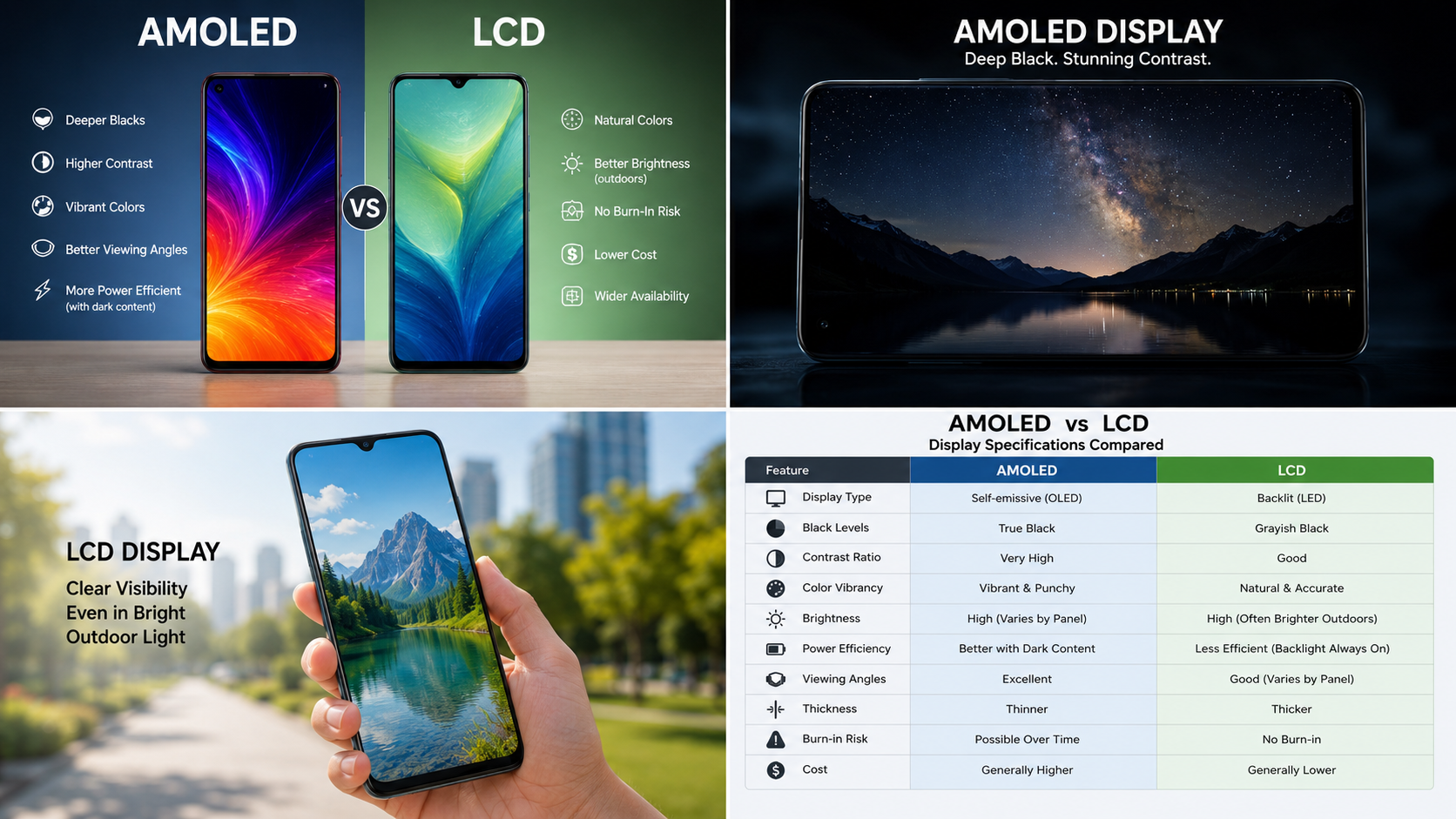
AMOLED vs LCD: Quick Comparison
| Feature | AMOLED | LCD |
|---|---|---|
| Display technology | Self-emissive pixels | Liquid crystal + backlight |
| Black levels | Excellent, true black | Usually lighter blacks |
| Contrast | Excellent | Good to very good |
| Colors | Often vivid and punchy | Often natural and consistent |
| Power efficiency | Can be excellent with dark content | Backlight remains active |
| Thickness | Generally thinner | Usually more layers |
| Viewing angles | Usually excellent | Depends on panel type |
| Burn – in risk | Possible over long-term use | No OLED – style burn – in |
| Price | Often found in mid – range/premium phones | Common on budget phones |
| Gaming | Excellent when paired with high refresh rate | Can also be excellent |
| Best for | Movies, gaming, dark mode, premium phones | Value – focused phones and many everyday users |
Read also :- How Much RAM Does a Smartphone Really Need ?
What Is an AMOLED Display ?
AMOLED stands for Active Matrix Organic Light – Emitting Diode. It is a type of OLED display in which individual pixels produce their own light.
Unlike a traditional LCD, an AMOLED panel does not need a separate backlight. When a pixel needs to display black, it can be switched off. This allows AMOLED screens to produce very deep blacks and very high contrast.
This is one reason AMOLED displays are common in premium smartphones, where manufacturers want a thin design and a high – contrast viewing experience.
How AMOLED Works
An AMOLED screen contains many individually controlled pixels. Each pixel can produce light rather than relying on a light source behind the entire display.
This gives AMOLED several important advantages:
- Deep black levels
- High contrast
- Strong color reproduction
- Fast pixel response
- Thin panel designs
- Potential power savings when displaying dark content
Not every AMOLED display is identical, though. Brightness, color tuning, refresh rate, resolution, HDR support and power efficiency can vary significantly between phones.
What Is an LCD Display ?
LCD stands for Liquid Crystal Display. Unlike OLED technology, LCD panels do not generate their own light. They use a backlight that shines through liquid crystals and color filters to create the image.
Smartphones have used several types of LCD technology, including IPS LCD and TFT LCD.
An LCD display can still look excellent when it has good calibration, high brightness, a suitable resolution and a fast refresh rate.
How LCD Works
An LCD smartphone display uses a backlight behind the display layers. Liquid crystals control how much light passes through each area, while color filters help create the required colors.
Because the backlight is separate from the individual pixels, an LCD cannot simply turn off individual pixels to create the same type of absolute black available from a self – emissive OLED panel.
AMOLED vs LCD: Main Differences
1. Black Levels and Contrast
This is one of the biggest differences.
AMOLED pixels can turn off completely when displaying black. As a result, dark areas can appear genuinely black rather than slightly gray.
LCD panels continue to rely on their backlight, so some light can remain present even when displaying a black image. Modern LCD technologies can improve black levels with techniques such as local dimming, but the backlight is still fundamentally different from individually controlled OLED pixels.
Winner: AMOLED
2. Colors
AMOLED displays are often known for vibrant colors and strong contrast. This can make photos, videos and games look more dramatic.
However, AMOLED does not automatically mean more accurate colors. Color accuracy depends on panel quality and how the manufacturer calibrates the display.
A good LCD can produce natural and accurate colors, while an AMOLED display can also be very accurate when properly calibrated.
Winner: Tie – depends on the specific phone
3. Brightness and Outdoor Visibility
Brightness is not determined solely by whether a phone uses AMOLED or LCD.
A high-quality AMOLED can be extremely bright, while a good LCD can also perform very well outdoors. Factors such as peak brightness, sustained brightness, reflectivity, display coating and automatic brightness behavior all matter.
Therefore, don’t choose a phone based only on the word “AMOLED” if outdoor visibility is important.
Winner: Depends on the panel and phone
4. Battery Life
AMOLED can have an efficiency advantage in situations where many pixels are displaying dark content. Because OLED pixels can reduce their output or turn off completely, dark areas can require less display power.
LCD displays use a backlight, which remains active while the display is operating.
However, AMOLED does not automatically mean longer battery life. Screen brightness, refresh rate, resolution, processor efficiency, software optimization and the type of content displayed all affect battery consumption.
For example, watching bright content at high brightness can change the power relationship considerably.
Winner: AMOLED in many dark-content scenarios, but real – world battery life varies
5. Viewing Angles
Modern AMOLED displays generally offer very good viewing angles because the pixels are self-emissive.
LCD viewing angles can also be good, particularly with quality IPS – type panels, but performance varies more between panel technologies and implementations.
Winner: Usually AMOLED
6. Display Thickness and Design
OLED technology does not require the traditional LCD backlight structure. This can allow manufacturers to build thinner display assemblies and create more flexible designs.
This flexibility has helped OLED become important in premium smartphones and foldable devices.
Winner: AMOLED
7. Burn – In and Long – Term Use
One area where LCD has an advantage is the absence of OLED – style permanent image retention or burn – in.
OLED displays can experience image retention or permanent uneven pixel wear after prolonged exposure to static elements under certain conditions. Modern smartphones use software and hardware techniques to reduce this risk, but it remains a consideration.
LCD does not have the same OLED pixel – aging mechanism.
Winner: LCD for avoiding OLED burn – in concerns
Read also :- https://www.flipkart.com/
AMOLED vs LCD for Gaming
For gaming, the display technology itself is only one part of the experience.
You should also consider:
- Refresh rate
- Touch sampling rate
- Response time
- Brightness
- Resolution
- HDR support
- Thermal performance
- Processor and GPU
- Battery capacity
- Variable refresh rate support
A 120Hz LCD can provide a smoother experience than a poorly optimized 60Hz AMOLED display.
However, a high – quality AMOLED with a high refresh rate can be excellent for gaming because of its contrast, fast response characteristics and vibrant presentation.
For gaming: Choose the better overall display specification, not simply AMOLED or LCD.
AMOLED vs LCD for Watching Movies
AMOLED is usually the better choice for movies and streaming.
Its ability to produce deep blacks and high contrast can make dark scenes look more impressive. Bright objects against dark backgrounds can also appear more distinct.
This is particularly noticeable when watching content with many dark scenes.
Winner: AMOLED
AMOLED vs LCD for Reading
For reading, the answer is less straightforward.
Both technologies can provide a comfortable reading experience when brightness, color temperature and font rendering are well adjusted.
If you read for long periods, consider:
- Brightness control
- Adaptive brightness
- Blue – light reduction features
- PWM behavior at low brightness
- Screen resolution
- Text sharpness
- Glare and reflections
Don’t assume AMOLED is automatically easier on your eyes. Display comfort varies between people and individual phone implementations.
Winner: Depends on the phone and user
AMOLED vs LCD for Outdoor Use
Outdoor visibility depends heavily on the specific display.
When comparing phones, look for information about:
- Peak brightness
- Typical brightness
- Sustained brightness
- Reflectivity
- Automatic brightness
- Outdoor visibility tests
A premium AMOLED can be exceptionally bright, but a well – designed LCD can also perform strongly outdoors.
Winner: Depends on the specific device
AMOLED vs LCD: Price and Value
LCD displays are still widely used in affordable smartphones because manufacturers can build competitive devices at lower price points.
AMOLED technology has become increasingly common beyond flagship phones, so the presence of AMOLED alone does not necessarily mean a phone is expensive.
When comparing two phones, don’t pay extra for AMOLED without considering the complete package.
A slightly more expensive phone may be worthwhile if it also provides:
- Higher refresh rate
- Better brightness
- Higher resolution
- Better processor
- Longer software support
- Better cameras
- Larger battery
- Better build quality
Best value: Depends on the complete smartphone, not just the display type.
AMOLED vs LCD: Which Is Better for You ?
Choose AMOLED if you:
- Watch lots of movies and videos
- Prefer deep blacks and strong contrast
- Use dark mode frequently
- Want a premium – looking display
- Play games frequently
- Prefer thin smartphone designs
- Want excellent viewing angles
Choose LCD if you:
- Want to keep the phone cost lower
- Prefer a more traditional display
- Are concerned about OLED burn – in
- Found an LCD phone with better overall specifications
- Care more about overall value than display technology
Common Mistakes When Comparing Phone Displays
Mistake 1: Assuming AMOLED Always Means Better
AMOLED is an advanced display technology, but implementation matters.
A cheap AMOLED panel can have worse brightness, calibration or viewing characteristics than a high-quality LCD.
Mistake 2: Looking Only at Resolution
A higher resolution can improve sharpness, but it isn’t the only important specification.
A good 1080p display with excellent brightness, calibration and refresh rate can be a better experience than a poorly implemented higher-resolution panel.
Mistake 3: Ignoring Refresh Rate
60Hz, 90Hz, 120Hz and higher refresh rates can make a noticeable difference in scrolling and supported games.
However, higher refresh rates can also increase power consumption depending on the device and usage.
Mistake 4: Believing AMOLED Automatically Saves Battery
AMOLED can be more efficient with dark content, but actual smartphone battery life depends on much more than the display type. Samsung Display notes that OLED power consumption varies with content and brightness, while LCD backlights remain active during operation.
Mistake 5: Comparing Only the Display Type
Instead of asking only “AMOLED or LCD ?”, compare the entire display specification:
Technology + brightness + refresh rate + resolution + color accuracy + HDR + touch response + software tuning.
What About OLED, Super AMOLED and Dynamic AMOLED ?
These names can be confusing.
OLED is the broader display technology category based on self – emissive organic light-emitting pixels.
AMOLED is an active – matrix implementation of OLED.
Super AMOLED is a display branding term used by Samsung for certain AMOLED displays.
Dynamic AMOLED is another Samsung display branding family associated with additional display features and improvements.
These marketing names should not be treated as a universal ranking system. A phone’s actual specifications and display quality matter more than the branding alone.
AMOLED vs LCD: Pros and Cons
AMOLED Pros
- Excellent black levels
- Very high contrast
- Strong viewing angles
- Can be power – efficient with dark content
- Enables thin and flexible designs
- Excellent for movies and dark scenes
AMOLED Cons
- OLED burn – in can occur under certain long-term usage conditions
- High – quality implementations can increase phone cost
- Color tuning varies between devices
- Battery efficiency depends on brightness and content
LCD Pros
- Can offer excellent image quality
- Common in affordable smartphones
- No OLED – style burn – in mechanism
- Mature and widely used technology
- Good LCD panels can have strong brightness and color accuracy
LCD Cons
- Requires a backlight
- Blacks are generally not as deep as OLED
- Usually less suitable for very thin or flexible display designs
- Contrast can be lower than a good AMOLED panel
How to Choose the Best Smartphone Display
Before buying a phone, check these specifications instead of relying only on the AMOLED or LCD label.
1. Check Brightness
If you regularly use your phone outdoors, brightness should be a priority.
2. Check Refresh Rate
For smoother scrolling and gaming, a higher refresh rate can be useful.
3. Check Resolution
Higher resolution generally provides greater pixel density, although the benefit depends on screen size and viewing distance.
4. Check HDR Support
If you stream compatible movies and shows, HDR support can improve highlights, contrast and overall image quality.
5. Check Display Protection
Look for the manufacturer’s stated screen protection and consider whether the phone is designed to withstand your normal usage.
6. Check Long – Term Support
A great display is less useful if the phone stops receiving important software and security updates too soon.
7. Compare the Complete Phone
Display quality should be considered alongside the processor, battery, cameras, software support, build quality and price.
Which Display Is Better: AMOLED or LCD ?
For most smartphone buyers, AMOLED is the better display technology overall.
It provides advantages such as deeper blacks, excellent contrast, strong viewing angles and the ability to control individual pixels. OLED’s self-emissive design also allows black pixels to be turned off, which can reduce display power consumption with dark content.
However, that does not mean every AMOLED smartphone is better than every LCD smartphone.
A well-tuned LCD phone with higher brightness, a faster refresh rate, better software support and a stronger overall hardware package can be a better purchase than a low-quality AMOLED phone.
Final Recommendation
Choose AMOLED if display quality, contrast, movies, gaming and premium viewing are your priorities.
Choose LCD if you want strong value and find a phone whose overall specifications are better for your needs.
The best smartphone display is not necessarily the one with the most impressive name. Look at the complete specification sheet and, when possible, compare real-world brightness, color accuracy, refresh rate and viewing quality.